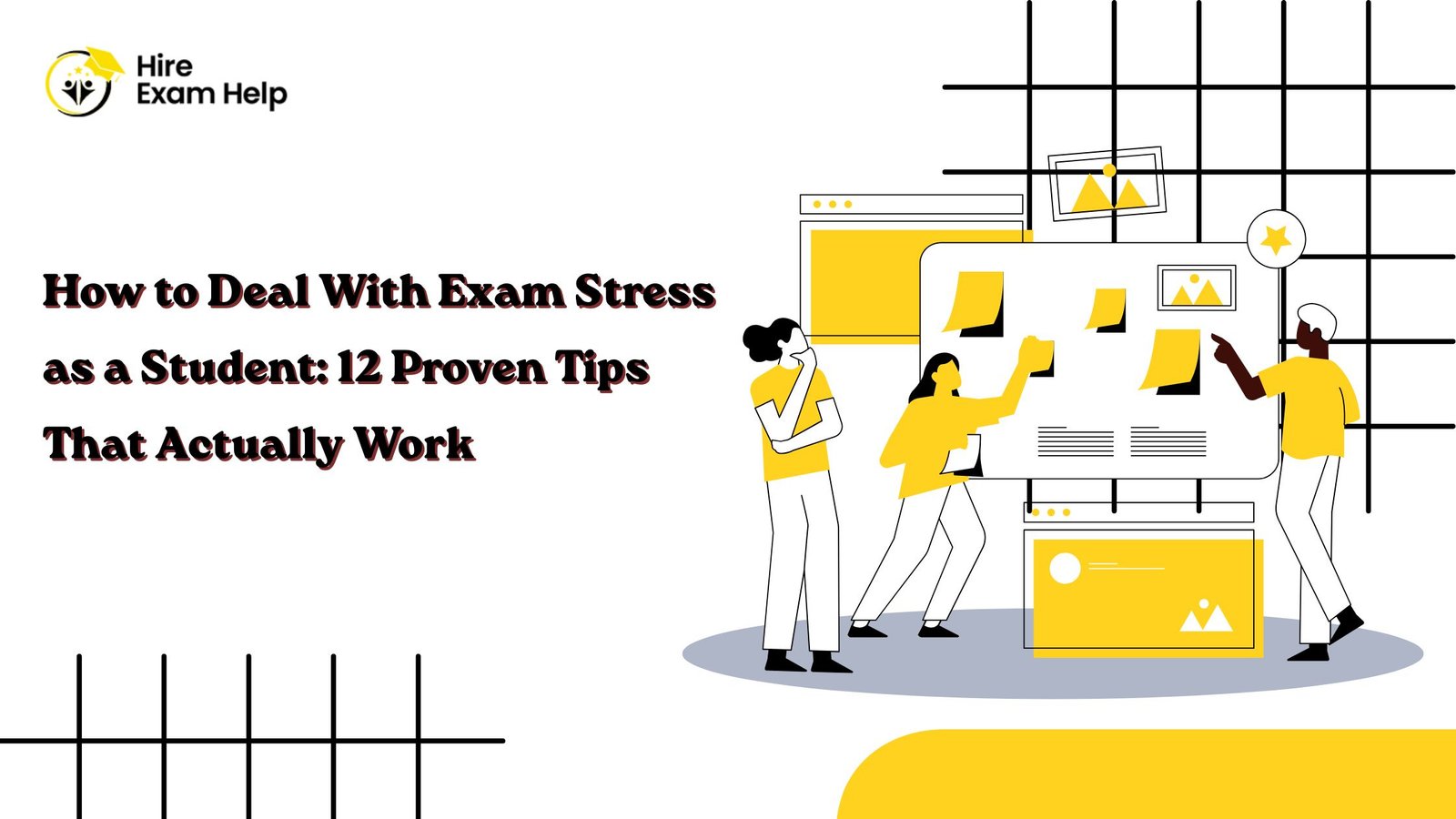


Certainly, the night before one of your important exams is definitely one of the worst. You’re nervous, your mind is just totally empty, and that’s why this blog exists. How to deal with exam stress, and all you’ll do after two hours of studying is not sleep at all. At 2 am, you will simply be lying there and staring at the ceiling, and getting crazy with worry about what could happen.
This one sad to say that all students have to face exam anxiety. Regardless of whether you are still in middle school, high school, or somewhere else in the middle. The good news? It’s definitely possible once you know what actually works, not just deep breathing tips but real, practical strategies that students use all the time.
This editorial will take you through how to handle exam anxiety from the night before until you get your exam paper in your hand.
Instead of diving into tips right away, it’s actually kinda useful to have some understanding of what really happens inside you. How your brain reacts when there’s a great deal of it on the line – your grade, your life, even your third set of parents’ opinion, when you’re under, we teach how to deal with exam stress.
And here’s the ins and outs. If you’re feeling under the water, the body produces the hormone cortisol that is inextricably tied to stress. A small amount of cortisol isn’t absolutely hating on us, since it lets us stay alert and sharp rather than boiling and running around like crazy. But once too much cortisol is released by your brain? Uh oh!
First, it kind of makes you forget all you previously knew before, then your hands shake like your fear, and lastly, your brain freaks out and starts totally melting down.
If any of those sound like you, keep reading. These 12 tips are going to help.
The majority of stress associated with exams can be attributed to the anxiety of not being ready. The reason why a lot of us are so hopelessly unprepared by the time an exam drags on is that we started too late. Well, yeah, it might be too obvious, but honestly, the most efficient way of how to deal with exam stress is by studying earlier. If you may ask, okay, my exam is in two weeks, but right now, open your notes. Just flick through them for 15 minutes.
That brief moment when you do something so simple sends a message to your brain, “I’ve got this,” and that alone makes a difference.
Studying for four hours in a row not only hurts but is actually less effective than doing 4 sessions of 45 minutes with breaks in between. Your brain stores information much better when it is getting some regular rest.
Do it Pomodoro style: study for a quarter of an hour, take 3/4 of a hundredth of a century off, then do it once more. After you do it four times, milord, you get a hundredth of an era – forget the nomenclature – off. You’ll be surprised by just how much knowledge you can take in, not forgetting how much stress you will get rid of.
Making an all-nighter makes you feel accomplished. It isn’t. That time you spend studying actually gets stored by your brain when you’re sleeping. If you don’t sleep, you wipe out most of the benefits of that time you spend studying.
Sleep for at least 7–8 hours the night before an exam. If you’re nervous about forgetting things, do a quick 20-minute review right before bed — your brain consolidates memory as you sleep.
If anxiety gets you in its grip, you will experience some irregularity in the pattern of your breath, and you will also feel your heartbeat pounding unnecessarily fast. Therefore, if at all you want to know about how to put an end to this cycle, then simply controlled breathing is what you need to go for.
For instance, you may opt for box breathing that entails breathing in (not in haste) for four, holding your breath for four, breathing out for four, and holding for another four. Repeat 4–5 times. Many athletes and members of the military also use the technique for calming nerves under pressure. It even works in the exam hallways.
No need to panic! Here’s how to cure anxiety in a jiffy: Take control of your breath. Try this: box breathing, breathe in for 4 beats, then hold your breath for 4, then breathe out for 4, then hold your breath again for 4. Do that 4–5 times. Athletes and military personnel do this to calm nerves when they’re under pressure. You can do it in exam hallways too..
Have you ever asked your friend if they studied for Chapter 7? Have you ever responded with I hardly slept? This exam’s gonna kill us all. If so, you have been part of the pre-exam stress parade, where everyone loses themselves and turns into a blubbering mess.
Don’t reply to the panic group chat prior to learning how to deal with exam stress. Whatever someone else has tested on or didn’t will matter when it comes to your exam performance. Do what you need to in order to focus on what YOU know.
There are too many benefits of working out to list here, but firstly, the act of working out will not only build up your muscles but also assist you in dealing with the feeling of anxiety. Why believe us and not try it out yourself? Just take a short walk around the block for 10 minutes! That will bring down cortisol levels in your body and clear your head!
If you’re anxious and stuck in a panic zone studying, go. Walk. Jumps. Come back in ten minutes, and you will be so much calmer.
Your brain’s got to have some glucose to work with. Not taking breakfast before an exam and trying to do anything is just like getting in your car with an empty tank. Tired, anxious, unfocused.
Tell me, though, what is it that you prefer to consume to keep yourself running? Was it eggs, oats, fruits, or even whole-grain toast? I, on the other hand, wouldn’t like to eat those high-fructose foods like cereal or energy drinks, which are, of course, junk food that will give me an instant shot in the arm but will have me falling flat on my face at the time I’m supposed to be at my best.
It may seem absurd, but listen to me on this one. Research carried out at UC Chicago has shown clearly that students did better on the exam if they wrote for ten minutes about what they were afraid of before taking the test than students who sat for the test without any prep whatsoever.
Putting the worries on paper gets them out of your head and into a safe and harmless place – and because it’s not in your head, it no longer takes up mental bandwidth that could be used to actually answer questions. Give it a try the night before or even immediately beforehand.
If you are not organised, you will keep revisiting the same pages again and again and keep thinking about stuff which you don’t have a clue about.
You should always write down what you are going to do every time you sit down to learn. It can be simple like <Chapter 4 notes + 10 practice questions>. Something about writing down what you’re going to do and actually doing it satisfies a supervillian.
That 10–15 minute window before you walk into the exam room is a make-or-break moment. Most students make it worse by panicking and flipping through notes or getting anxious with friends. Instead, try this: remove your notes, put in earbuds if you have them, breathe slowly, and tell yourself 2–3 things you absolutely know. Now your brain isn’t frantic anymore, but instead confident and ready.
Sometimes students confuse how to deal with exam stress, which tips over into something more than regular nerves. If for weeks you’re feeling out of control, falling asleep every other night, or becoming totally lost about school, please speak with somebody: a guardian, instructor, school guidance counsellor, or trusted friend.
Student mental health is a very real phenomenon, and it’s recognised as such. Everyone has to hold on tight during every exam period on their own.
If you are having a hard time with particular courses and your test is practically around the corner, then there is no room to wait until it is too late. There are some great ways of catching up quickly, and they are really very effective.
You will be surprised how much online exam help you can get by way of participating in tutoring platforms and taking practice tests, as well as listening to video instructions, especially if your course is one of the math or science courses, because you will need to grasp the entire concept rather than simply learn the facts.
Here’s something many students are unaware of: the strategies listed above do not solely pertain to the time when preparing for exams. Rather, they are practices. Students who appear to be calm and confident during exams are not inherently different; they simply possess the practice of handling stress throughout the year.
Don’t get carried away. Choose a mere 2 or 3 from the above and incorporate them into your weekly routine. Rest, exercise, and study early will teach you way more than a cram session will.
The cause of most test anxiety is ambiguity – you are uncertain whether you have studied enough. The only genuine cure for that is well-timed practice. It doesn’t have to be perfect practice, just consistent.
Allow me to help you make a change in your mentality: Instead of trying to “know everything,” aim to be “as prepared as you reasonably can be given your time.” That simple reframe relieves so much stress by itself.
Here’s a simple framework that works really well for most students:
Following a timeline like this removes so much of the guesswork — and it’s the guesswork that fuels anxiety.
Knowing how to deal with exam stress is, without a doubt one of the most useful skills each student can learn–not to mention, unlike many other subjects, is a skill that always has implications of dependency.
Students who excel in examinations are, of course, not the cleverest students in the class. They are individuals who get enough sleep, organise their scholarship well, and learn how to cool down if the heat is on. That can be you.
Choose a couple of tips from this guide and begin using them today–not on the night before your next achievement. Begin now. Little modifications build up, and by the time u think about how to deal with exam stress, a paper lands in front of you, you will be so much more prepared than you were before.
And bear in mind–if you are ever stuck on particular topics, there is no shame in looking for an online exam helper to close the gaps. Asking for assistance if you need it is a sign of a wise student versus a failing one.
Do a 20-minute run-through of those important enough columns and then put away the books. Get your clothes and test materials together, eat a decent meal, and hit the sack on time. Your brain needs sleep more than time to cram at this point.
This is a classic example of how to deal with exam stress retrieval failure under stress, which is extremely common. When your stress hormones are on the rise, they can transiently impair access to memories. The solution is to calm your nervous system first — take 3 slow breaths, write down whatever you do remember, and come back to the blank question later.
While mild how to deal with exam stress is totally understandable, and I’d hazard most people go through it to some degree, if your anxieties are seriously bad, last for a while, or pop up outside of exams, I think MB’s advice makes sense, and it might be worth talking to a school counsellor/mental health professional instead of thinking how to deal with exam stress.
Eat some breakfast, get somewhere early enough to not be rushing, don’t have those panic conversations with your friends/classmates, do box breathing in the waiting area, and remind yourself that you studied, you’ve revised, you’re ready. Once you start reading the questions, your brain is normally back in focus mode.